
The Worthing and Adur Swift Group has had a bumper season attracting Swifts with nest boxes and callers, partially funded by Sussex Ornithological Society (SOS). Their results show how local projects can help these Red-listed birds, and how groups in Sussex can access our funding to make a difference in their communities.
Swifts: an iconic species in jeopardy
Swifts spend nearly their entire lives on the wing. They feed, drink and mate in flight, and are even believed to sleep while flying — closing off one part of their brains to rest while another part, still awake, keeps them aloft.
“They’re a really iconic bird because they nest in houses, so they have a proximity to humans that makes them very visible,” explains Dave Boddington, the Swift Champion at SOS. Their dependence on humans has made them vulnerable as our habits have changed — but it also means that we can take steps to protect them.
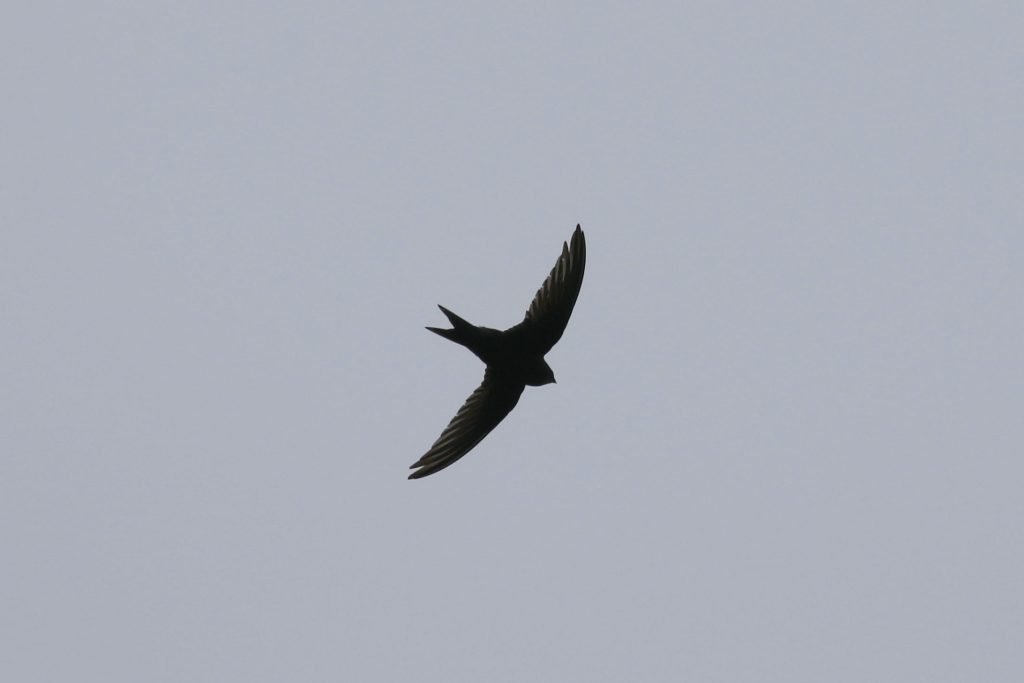
Swifts are now a Red-listed Bird of Conservation Concern, with their population crashing over the last few decades. As of the 2025 Breeding Bird Survey, they’ve experienced a 70% population decline in the UK between 1995 and 2024. Two major factors are believed to have had an impact on this:
- A lack of suitable nesting sites. Older buildings were more likely to have space under the eaves or small crevices in walls where Swifts could nest, while new buildings are designed for greater thermal efficiency and lack the nooks and crannies they seek. Additionally, many old nest sites have been lost due to the installation of new plastic fascia and soffit boards blocking their access.
- Changes to their food supply. Swifts are dependent on airborne insects. Pollution, pesticides, and climate change have impacted these insects, resulting in a shrinking food supply.
Nesting habits
Swifts start their first non-stop flight to sub-Saharan Africa at just six weeks old and often do not land again for two to three years. When they return to the UK, they do so in waves — first, experienced adults return to their favourite nesting sites; then younger birds return to build their first nests; then yearlings return to investigate colonies and prospect sites for future nests.
Once they’ve selected a preferred nesting site, adults will usually return to the same one every year. If their nesting site is moved or blocked, finding a new one can cost them an entire breeding season. This makes it tremendously important for them to have locations they can depend on.
Swift boxes and callers
This is where swift boxes come in: purpose-built boxes, ideally with a large internal cavity and an elongated entrance. Some can be placed under the eaves of existing buildings, and some — created with the same dimensions as a standard brick — can be built into the walls of new builds.
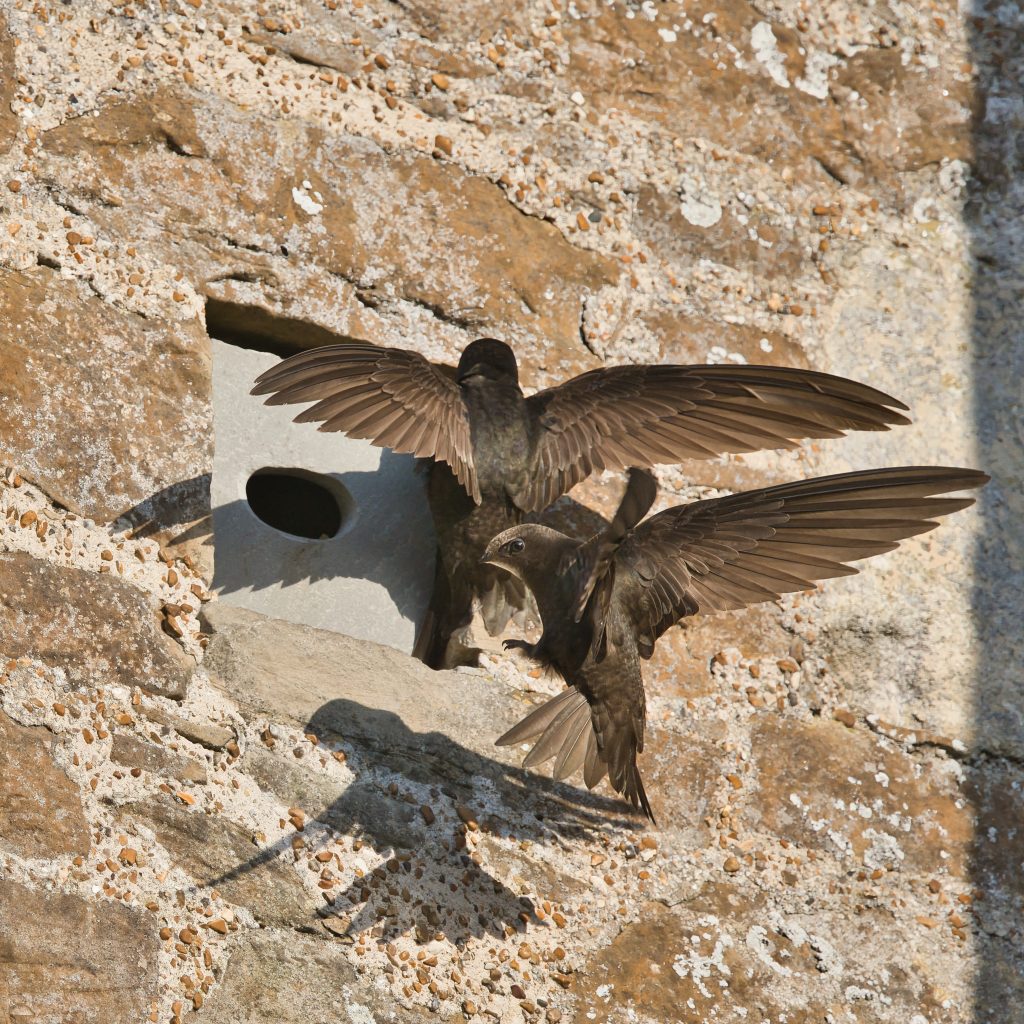
Once a box has been installed, a small speaker that emits swift calls, known as a caller, can also be installed to help the birds notice the box.
When local groups undertake projects to attract Swifts to their neighbourhoods, SOS can provide grants to help them install both swift boxes and callers, depending on their needs.
Successes of the Worthing and Adur Swift Group
In 2026, the Worthing and Adur Swift Group (W&ASG) has had great success with their swift boxes and callers. Homeowners paid for their own boxes and some callers, and 37 of their 57 callers were funded by SOS. Several boxes have already been earmarked by birds for occupation next year — and, since boxes without callers can remain unoccupied for many years and the boxes were installed only this year, this is an exciting result.
In their end-of-season report, the group shared heartening signs about their local Swift colonies:
- At a local church where a caller was retrofitted mid-season, Swifts soon began circling the tower for the first time in years.
- A group member filmed about a dozen prospecting Swifts “besieging” two boxes with a solar-powered caller a few weeks after their installation.
- A householder reported Swifts in her back garden within a day of her box and caller being installed.
- One caller led Swifts to start regularly entering not only the box with the caller, but also two neighbouring boxes. One bird carried feathers into a box, a promising sign of a young pair firmly claiming the box to return and breed next year.
Swift enthusiasts at W&ASG and SOS believe that the high proportion of caller-assisted boxes in the area will greatly accelerate occupation. The waves of young birds and yearlings that have visited the area this year will hopefully result in many young chicks in the years to come.
“We are highly appreciative of the support that SOS has given us this season,” says Steve Lawless of W&ASG. “It has definitely increased the effectiveness of our swift conservation work.”
Applying for SOS funding
If you are undertaking a project to benefit local birds, SOS can help. On our Grant Applications page, you can submit details about your project and its location, costs, and benefits through an online form. We’ll evaluate your project and follow up with you.
Funding local projects is a key part of our mission, and we’re delighted to assist with work that directly helps birds in Sussex.